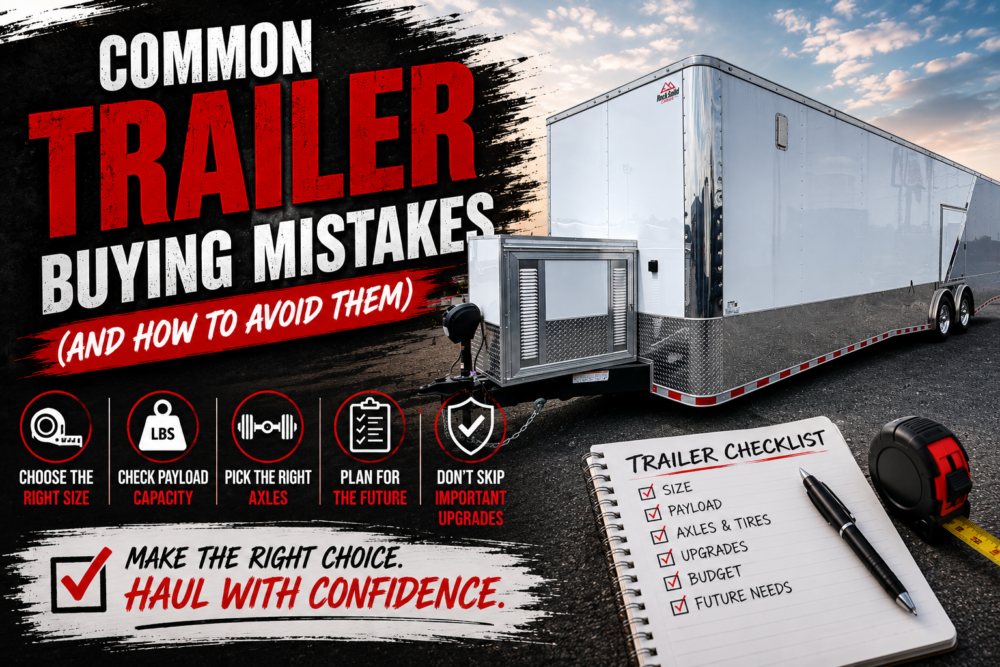
Buying an enclosed cargo trailer, concession trailer, race trailer, or car hauler is a significant financial investment. Making the wrong choice doesn’t just hurt your wallet—it leads to expensive aftermarket modifications, poor highway towing performance, or outgrowing your rig much sooner than expected.
Whether you are a commercial contractor buying your first utility setup or a racer upgrading to a massive haul, avoiding these ten critical mistakes will save you time, money, and highway frustration.
At-a-Glance: Enclosed Trailer Buying Guide
| The Mistake | The Real-World Risk | The Renown Solution |
| Buying Too Small | Outgrowing payload space within 6 months | Upgrade one size larger than your current inventory |
| Wrong Axle Rating | Bent axles, blowout risks, and structural sagging | Upgrade from 3,500 lb to 5,200 lb or 7,000 lb axles |
| Standard Height | Scalped heads and low ramp door clearance | Choose a 7-foot or taller interior height package |
| Price-Shopping | Warped exterior skins and weak frames | Invest in .080 Polycore and heavy-duty tube steel frames |
1. Buying Too Small (Why Size Matters for Cargo vs. Race Trailers)
One of the most frequent mistakes buyers make is purchasing the absolute smallest trailer they think they can get away with today. Once you add workbenches, toolboxes, custom shelving, or load up heavy equipment like ATVs, UTVs, and side-by-sides, that open space vanishes fast.
How to avoid it: Anticipate your future business or hobby growth. If you plan to expand your crew, buy more inventory, or haul larger vehicles next year, stepping up to a larger footprint now (such as going from an 8.5×16 to an 8.5×24) is significantly cheaper than trading in a small trailer down the road.
2. Choosing the Wrong Axle Weight Rating (3,500 lb vs. 5,200 lb vs. 7,000 lb Axles)
Not all trailers are engineered to handle heavy payloads. Many budget-tier enclosed trailers feature entry-level 3,500 lb leaf spring axles. While fine for light-duty residential hauling, these setups fail under commercial stress.
How to avoid it: If you are hauling heavy landscaping equipment, muscle cars, or commercial contracting gear, look into upgrading to dual 5,200 lb or 7,000 lb tandem axles. Furthermore, decide between standard leaf spring axles and premium torsion axles, which offer a smoother ride and independent wheel suspension for your high-value cargo.
3. Ignoring Payload Capacity and GVWR (Gross Vehicle Weight Rating)
Many buyers focus entirely on the exterior dimensions of the trailer while completely ignoring its legal hauling limits. For example, two separate trailers can both measure 8.5×20, but one might haul thousands of pounds more depending on its triple-tube tongue design, frame crossmember spacing, and axle configurations.
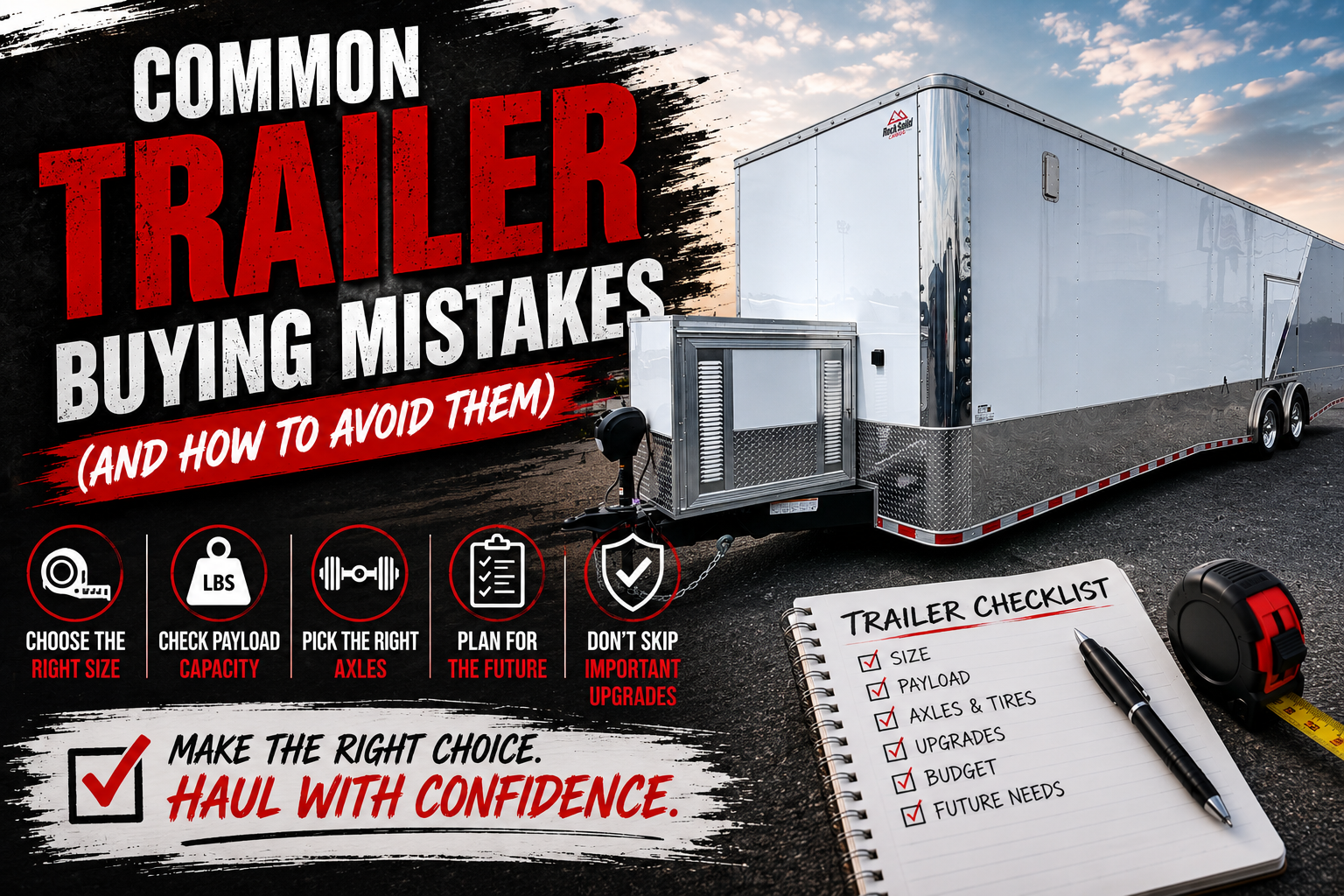
How to avoid it: Before signing any paperwork, always calculate these three critical metrics:
- GVWR (Gross Vehicle Weight Rating): The maximum allowable total weight of the trailer plus cargo.
- Empty Trailer Weight: The baseline weight of the structure before loading.
- Maximum Payload Capacity: GVWR minus empty trailer weight. This tells you exactly how much weight you can safely pack inside.
4. Overlooking Trailer Interior Height (Why 7-Foot Interior is Better)
Standard interior heights are built for basic boxes, not mobile workspace efficiency. If you plan on standing inside your trailer for hours at a time, ignoring clearance can make your daily operations miserable.
How to avoid it: Upgrading to a 6’6″, 7-foot, or taller interior height provides massive real-world advantages:
- Walking and working comfortably without slouching.
- Installing overhead cabinets and storage racks.
- Maximizing the rear ramp door clearance for tall commercial mowers or lifted off-road vehicles.
- Creating compliant clearances for mobile workstations and food truck builds.
5. Skipping Crucial Factory Upgrades (.080 Polycore Skin & Semi-Screwless Panels)
It is always cheaper to build it right at the factory than it is to retrofit modifications in an aftermarket shop later.
How to avoid it: Plan your build sheet ahead of time. High-value factory options that drastically protect your investment include:
- .080 Polycore Exterior Skin: Eliminates the wrinkling and warping common with thin .030 aluminum panels.
- Semi-Screwless Construction: Provides a clean, smooth exterior surface perfect for business wraps.
- Extended Triple Tube Tongue: Improves towing stability and turning radius clearance.
- Interior Utility Gear: E-Track tie-down systems, recessed winches, and built-in tool cabinets.
- Climate Controls: 15,000 BTU roof A/C units, insulated walls, and dedicated generator compartments.
6. Buying Based on Price Alone
While a bargain price tag is tempting, the cheapest enclosed cargo trailer on the lot is usually cheap for a reason. Budget manufacturers often cut corners using thin crossmember spacing, weak plywood decking, and cheap hardware components.
How to avoid it: Look for long-term value over upfront savings. A premium-built trailer features sturdy main frame tube steel, closer wall post spacing (16″ on center), high-grade radial tires, and strong manufacturer warranties. Spending a few hundred dollars more upfront prevents thousands of dollars in frame repairs and structural failures down the highway.
7. Forgetting About Truck Towing Capacity
A trailer is only as safe as the tow vehicle pulling it. Buying a massive, loaded tandem-axle or gooseneck trailer without evaluating your current truck can ruin your transmission, warp your brakes, or create dangerous sway conditions on the interstate.
How to avoid it: Check your vehicle owner’s manual to verify your truck’s maximum towing capacity, tongue weight limits, and receiver hitch rating. Additionally, ensure your vehicle is equipped with a high-quality weight distribution hitch and a functional electric brake controller to handle tandem axle stopping power.
8. Not Thinking About Future Multi-Use Functionality
A trailer bought for one specific job today often becomes the solution for an entirely different project tomorrow.
- A standard landscape cargo trailer evolves into a mobile contractor workshop.
- A standard car hauler gets upgraded into an enclosed weekend race trailer setup.
- A basic utility trailer gets fitted with concessions for a mobile vending business.
How to avoid it: Buy a versatile platform. Choosing an adaptable layout with structural crossmembers, extra interior height, and solid plywood floors gives you a clean canvas that can be easily modified as your business or hobbies pivot.
9. Ignoring Warranty and Dealer Support
A premium trailer is only as dependable as the dealership network backing it up. Buying from a fly-by-night operation or an unverified private seller means you are completely on your own if an axle snaps or a roof seam leaks.
How to avoid it: Buy from an established, reputable dealer that offers explicit, nationwide structural warranties. Ensure your dealer has a dedicated customer service team capable of sourcing replacement parts, handling factory warranty claims, and answering technical questions long after you drive off the lot.
10. Not Asking the Right Questions
The worst mistake any trailer buyer can make is staying quiet when they don’t understand the specs. Frame configurations, wiring harnesses, braking systems, and payload mechanics can be confusing.
How to avoid it: Leverage the knowledge of an industry expert. Ask your dealer to explain the precise structural differences between models, walk you through available financing packages, or explain no-credit-check rent-to-own programs.
Final Thoughts: Ready to Find the Perfect Build?
The ideal trailer should comfortably handle your toughest workloads today while providing the scaling room you need for tomorrow. By paying close attention to axle ratings, payload metrics, structural materials, and interior heights, you can bypass the costly mistakes that trap average buyers.
At Renown Cargo Trailers, we help contractors, haulers, racers, and small business owners build out their dream rigs every single day. Whether you need a standard commercial haul or a completely customized enclosed setup, our team is dedicated to getting you on the road with total confidence.
Stop Guessing. Build to Last.
Call Renown Cargo Trailers Today: 888-287-3954
Come See Us: Visit our flagship location in Douglas, GA. Nationwide Delivery: Can’t make the drive? We offer nationwide hotshot delivery straight to your driveway or job site!