
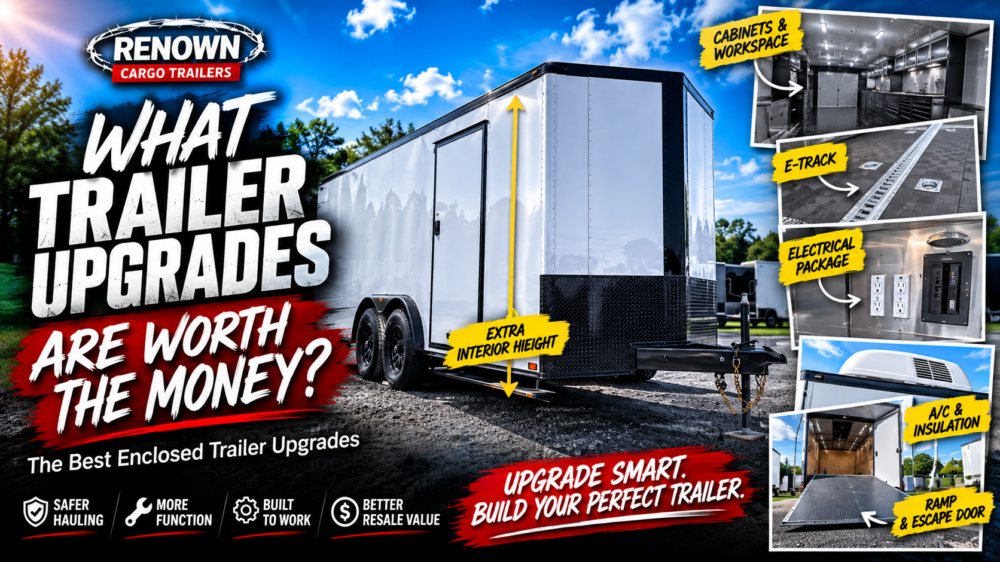
Buying an enclosed trailer is only the beginning. The right upgrades can make your trailer safer, easier to use, better suited for your work, and more valuable for years to come.
But which trailer upgrades are actually worth the money?
That depends on what you’re hauling and how you plan to use your trailer. A contractor, race team, landscaper, mobile business owner, and weekend hauler don’t necessarily need the same setup.
Some upgrades improve the structure and hauling capability of the trailer. Others add convenience, comfort, organization, or appearance. And then there are upgrades that sound great on paper but may not be worth paying for unless your particular application calls for them.
If you’re shopping for an enclosed cargo trailer or planning a custom trailer build, here’s where we’d put the money first.
1. Axle Upgrades: Spend Money Where It Matters
If your trailer will regularly carry substantial weight, an axle upgrade can be one of the smartest investments you make.
Axle capacity needs to match the trailer’s intended GVWR, frame, tires, wheels, coupler, brakes, and overall design. Simply installing heavier axles does not automatically increase a trailer’s legal payload or GVWR.
However, when you’re ordering a trailer designed from the beginning for heavier-duty use, properly matched higher-capacity axles can make sense for applications such as:
- Construction equipment
- Landscaping equipment
- Race cars and automotive equipment
- Heavy tools and machinery
- Commercial hauling
- Mobile businesses carrying significant equipment
For lighter loads, paying for substantially more capacity than you’ll ever use may not provide much benefit.
Is an axle upgrade worth it?
Yes, when your expected load requires it.
This is one upgrade where you should think about what you’ll be hauling two or three years from now, not only what you’re hauling today.

2. Extra Interior Height
This is one of the most underrated enclosed trailer upgrades.
Standard interior height may work perfectly for basic cargo. But additional height can completely change how useful a trailer feels.
Extra interior height is especially valuable for:
- Contractors
- Tall equipment
- UTVs
- Race applications
- Mobile workshops
- Concession trailers
- Mobile grooming trailers
- Equipment storage
- Shelving and cabinetry
It can also make a trailer feel considerably less cramped when you’re actually working inside it.
Is extra trailer height worth the money?
For many commercial buyers, absolutely.
It’s also an upgrade that’s considerably easier to decide on before the trailer is built than after you own it.
3. E-Track and Additional Tie-Down Points
A beautiful trailer isn’t very useful if you can’t properly secure what’s inside it.
That’s why E-track is one of our favorite functional trailer upgrades.
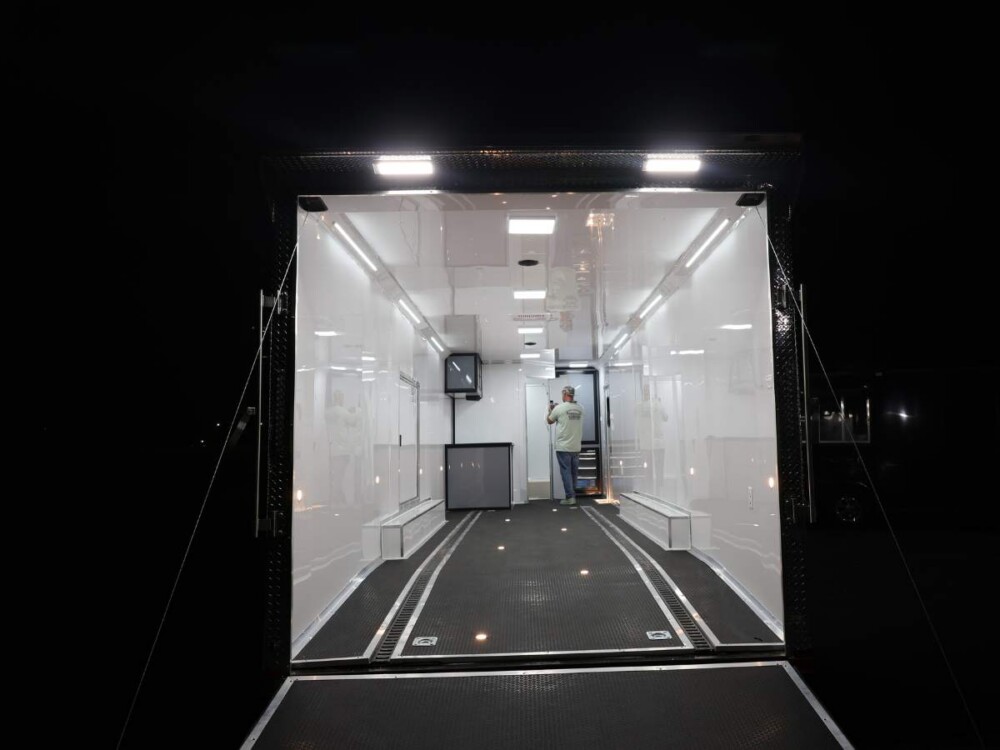
E-track gives you configurable anchor points that can work with straps, hooks, rings, and other accessories. Depending on your application, it can be installed on the floor, walls, or both.
It’s useful for securing:
- Equipment
- Motorcycles
- Toolboxes
- Furniture
- Appliances
- Tires
- Rolling carts
- Commercial equipment
- General cargo
Traditional recessed D-rings are also an excellent choice when you have predictable tie-down locations.
E-track vs. D-rings
You don’t necessarily have to choose one or the other.
D-rings work extremely well for fixed heavy-duty tie-down locations.
E-track provides much greater flexibility when your cargo changes regularly.
For many working trailers, having both creates an extremely versatile cargo-management system.

4. Electrical Packages
If your enclosed trailer will function as anything more than a cargo box, an electrical package can quickly become one of the upgrades you appreciate most.
Depending on the build, an electrical package may include:
- Breaker panel
- Shore-power connection
- Interior outlets
- Exterior outlets
- LED lighting
- Light switches
- Dedicated circuits
- A/C preparation
- Battery systems
This is particularly valuable for contractors and mobile businesses that use their trailers as actual workspaces.
Think about plugging in tools, charging batteries, running equipment, adding better lighting, or eventually installing climate-control equipment.
Is trailer electrical worth it?
If you’re going to work inside the trailer, there’s a strong argument for having the electrical infrastructure incorporated during the original build.
Planning electrical needs before construction can also produce a much cleaner installation than trying to retrofit everything later.
5. LED Interior and Exterior Lighting
Don’t underestimate lighting.
A couple of basic lights may be enough for occasional hauling. But if you’re loading equipment before sunrise, unloading after dark, or working inside the trailer, additional LED lighting is money well spent.
Consider:
- Additional ceiling LEDs
- Rear loading lights
- Exterior scene lights
- Porch/entry lighting
- Work-area lighting
Good lighting is relatively simple, but it can dramatically improve everyday usability.
6. Extended Tongue
An extended tongue isn’t exciting to look at, but it can be an extremely practical upgrade.
Depending on the trailer and tow vehicle, additional tongue length can provide more clearance between the trailer and tow vehicle during tight turns and backing maneuvers.
It can also create additional room for certain tongue-mounted equipment when the trailer is designed appropriately.
Whether you need one depends heavily on the trailer configuration and tow vehicle, so this is an upgrade worth discussing when you spec the trailer.
7. Ramp Door and Ramp Extensions
If you’re loading cars, motorcycles, lawn equipment, carts, or machinery, don’t treat the rear ramp as an afterthought.
The loading angle matters.
Low-clearance vehicles are particularly sensitive to the transition between the ground, ramp, beavertail, and trailer floor.
Depending on the application, worthwhile options can include:
- Heavy-duty ramp door
- Spring-assist ramp
- Extended transition flap
- Beavertail
- Additional ramp length
- Rear stabilizers
For race trailers, this can be essential.
A trailer can have every luxury option available and still be frustrating if your car scrapes every time you load it.

8. Escape Door for Car Haulers
If you’re buying an enclosed car hauler, put an escape door high on your list.
Once a vehicle is inside an enclosed trailer, opening the driver’s door can become difficult or impossible because of limited clearance between the vehicle and trailer wall.
A properly configured escape door provides access alongside the vehicle and can make loading and unloading substantially easier.
For frequent automotive hauling, this isn’t just a flashy option.
It’s a convenience you’ll appreciate nearly every time you use the trailer.
9. Insulation
Is trailer insulation worth the money?
Sometimes absolutely—and sometimes not at all.
If you’re simply transporting equipment from Point A to Point B, insulation may not be where we’d spend the budget first.
But insulation becomes considerably more valuable when the trailer is used as:
- A mobile workspace
- Grooming trailer
- Concession trailer
- Race trailer workspace
- Mobile office
- Climate-controlled equipment trailer
Insulation becomes particularly important when you’re adding heating or air conditioning.
There’s little point in paying to condition the air inside a trailer only to let that energy escape through an inadequately insulated structure.
10. Air Conditioning and Roof-Vent Preparation
A/C sounds fantastic—especially during a Southern summer—but not every trailer needs it.
If people will spend significant amounts of time working inside the trailer, climate control can be worth every penny.
If the trailer primarily transports equipment and stays closed most of the day, you may get considerably more value from spending that money somewhere else.
One smart compromise is to have the trailer properly framed and wired for future A/C during the build.
Then, if your needs change, the infrastructure is already there.
Roof vents and sidewall ventilation can also improve airflow in applications where full air conditioning isn’t necessary.

11. Upgraded Flooring
Your trailer floor takes abuse.
Mud, tires, equipment, tools, chemicals, water, and constant foot traffic can make flooring more important than buyers initially realize.
Available upgrades may include:
- Rubber coin flooring
- Aluminum tread plate
- Commercial vinyl
- Specialty flooring
- Finished race-trailer flooring
The right flooring depends on the job.
A contractor may prioritize durability and easy cleaning. A race trailer owner may want something finished and professional. A mobile business may need a surface designed around sanitation and frequent cleaning.
Don’t buy flooring solely because it looks good.
Buy it because it fits how you’ll use the trailer.
12. Cabinets, Shelving and Storage
Organization can turn an ordinary enclosed trailer into a serious mobile workspace.
Cabinets and shelving are particularly useful for:
- Contractors
- Race teams
- Mobile mechanics
- Landscapers
- Detailers
- Groomers
- Concession operators
The important thing is to design storage around your workflow.
Where will you stand?
What equipment do you reach for most?
Where will heavy items be positioned?
How will the load affect tongue weight and overall trailer balance?
Good trailer storage isn’t simply about fitting more stuff inside. It’s about making the trailer easier and safer to use.
13. Spare Tire and Spare Tire Mount
This one isn’t glamorous.
We’d still put it high on the list.
A spare tire doesn’t feel important until you’re sitting beside the highway with a damaged tire and an otherwise perfectly usable trailer.
For trailers that regularly travel long distances, a properly sized spare tire and secure spare-tire mount are inexpensive insurance against a very frustrating day.
14. Blackout Packages and Appearance Upgrades
Now we’re getting into the fun stuff.
A blackout package can include black:
- Trim
- Wheels
- Fenders
- Door hardware
- Stone guard
- Exterior accents
Does a blackout package make your trailer haul better?
No.
Can it make the trailer look dramatically better?
Absolutely.
And appearance isn’t always frivolous.
For a business, your trailer may essentially be a rolling billboard. A clean, professional trailer can reinforce your company’s image every time you pull onto a job site.
If you’re trying to maximize utility on a strict budget, however, we’d spend money on structural and functional upgrades first.
Which Trailer Upgrades Give You the Best Value?
If we had to prioritize upgrades for a typical enclosed cargo trailer, we’d think about them in this order:
PRIORITY 1: CAPABILITY & SAFETY
Axles • Brakes • Tires • Appropriate GVWR • Structural configuration
Make sure the trailer is actually designed for what you’re asking it to carry.
PRIORITY 2: FUNCTION
Tie-downs • E-track • Ramp configuration • Escape door • Extra height • Spare tire
These are the upgrades you’ll notice every time you use the trailer.
PRIORITY 3: WORKABILITY
Electrical • Lighting • Insulation • Ventilation • A/C preparation • Storage
These matter tremendously when the trailer becomes a mobile workspace.
PRIORITY 4: APPEARANCE
Blackout package • Premium wheels • Interior finishes • Exterior upgrades
Once the trailer does everything you need it to do, make it look the way you want.
Which Trailer Upgrades Are NOT Worth the Money?
There’s no universal list of “bad” trailer upgrades.
An upgrade becomes a waste of money when you pay for something your application doesn’t need.
For example:
An occasional weekend hauler may not need a sophisticated electrical system.
A cargo-only trailer may not need full insulation and rooftop A/C.
A lightweight load doesn’t automatically justify upgrading to the heaviest axle package available.
A contractor who destroys floors for a living probably doesn’t need an expensive decorative interior floor.
On the other hand, those exact same options could be essential to another buyer.
The best trailer isn’t the one with the most upgrades. It’s the one configured correctly for the job.
Should You Add Trailer Upgrades During the Build or Later?
Whenever possible, identify the difficult upgrades before the trailer is built.
Structural changes, additional height, axle configuration, doors, windows, framing, electrical wiring, A/C bracing and certain flooring or wall systems are much easier to incorporate correctly during manufacturing.
Accessories that bolt or mount into an existing structure can often be added later.
Before ordering, make two lists:
MUST HAVE
Anything necessary for the trailer to perform its intended job.
NICE TO HAVE
Anything you’d enjoy but could live without if the budget gets tight.
Spend the money on the must-haves first.
Do Trailer Upgrades Increase Resale Value?
The right upgrades can make a used trailer more desirable, but don’t assume you’ll recover every dollar you spend.
Broadly useful upgrades tend to appeal to more future buyers than highly specialized modifications.
Features such as practical tie-down systems, appropriate axle capacity, good lighting, useful doors, quality flooring, electrical infrastructure, and a clean professional interior may increase buyer appeal.
Highly customized equipment can be extremely valuable to the right buyer—but may narrow the pool of potential buyers.
If resale matters, build for your needs while avoiding modifications so specialized that the trailer becomes useful to only one person.
Don’t Forget the Warranty
Before comparing trailers solely by price and options, look at what’s behind the trailer after the sale.
At Renown Cargo Trailers, enclosed trailers come with a manufacturer-backed nationwide warranty, with coverage typically ranging from three to five years depending on the manufacturer.
That matters because a bargain-priced trailer isn’t much of a bargain if you’re on your own when something goes wrong.
New vs. Used: Upgrades Change the Equation
A used trailer can look inexpensive until you start adding everything it doesn’t have.
If you know you need specific interior height, electrical, doors, tie-downs, axle configuration, or other custom features, compare the total finished cost rather than simply comparing the initial purchase prices.
Sometimes buying new with the correct options from the beginning makes more financial sense than buying used and modifying it extensively afterward.
Check out our Blog here: New vs. Used Enclosed Cargo Trailer: Which Is the Smarter Buy?
Frequently Asked Questions About Enclosed Trailer Upgrades
What is the best upgrade for an enclosed trailer?
There isn’t one best upgrade for everyone. For working trailers, proper load capacity, tie-down systems, electrical and lighting are among the most useful upgrades. The best choice depends on what you haul and how you use the trailer.
Is E-track worth putting in a cargo trailer?
For buyers who haul different types of cargo, E-track can be extremely useful because it provides adjustable tie-down locations instead of limiting you to fixed anchor points.
Is extra height worth it on an enclosed trailer?
Extra height can be an excellent investment if you carry tall equipment or regularly work inside your trailer. It’s especially useful for commercial and specialty applications.
Is it worth insulating an enclosed trailer?
Insulation makes the most sense when people work inside the trailer or when you’re adding heating or air conditioning. For basic cargo transportation, other upgrades may deserve priority.
Should I upgrade my trailer axles?
Only when the trailer’s intended load and overall design call for additional capacity. Axles are only one component of a trailer’s weight rating, so an axle change alone should never be assumed to increase GVWR.
Is an enclosed trailer electrical package worth it?
For mobile workshops, commercial trailers and other applications where you’ll use powered tools, lighting or equipment, an electrical package can be one of the most useful upgrades.
What upgrades should I get on a car hauler?
Car-hauler buyers should consider an escape door, appropriate tie-downs, a properly designed ramp/beavertail combination, adequate axle and tire capacity, lighting and a winch setup depending on the vehicles being transported.
Build the Trailer Around the Job
The smartest way to buy an enclosed trailer isn’t to check every option on the order sheet.
Start with one question:
What does this trailer need to do for me?
Then build around that answer.
A contractor’s perfect trailer won’t look like a race team’s perfect trailer. A mobile groomer’s trailer won’t look like a landscaper’s. And someone hauling motorcycles on weekends doesn’t need to pay for every feature required by a full-time commercial operator.
That’s the advantage of having choices.
At Renown Cargo Trailers, we can help you compare trailer sizes, manufacturers, options and custom configurations so you’re spending money where it actually makes a difference.
Ready to Find the Right Trailer?
Whether you’re looking for an enclosed cargo trailer, car hauler, race trailer, concession trailer, dump trailer, or specialty custom trailer, talk with our team about how you plan to use it.
We’ll help you determine which upgrades make sense—and which ones you can skip.
SHOP ENCLOSED TRAILERS IN STOCK →
CALL 888-287-3954
Renown Cargo Trailers
Douglas, Georgia
Nationwide Delivery Available
If you can dream it, we can build it!